
Invoices are how you bill the instructing firm for your own work on a matter: drafting the bill of costs and attending its taxation. Receipts record the payments you get and allocate them to those invoices, so you always know what is still owed. Both are kept per matter, and you reach them from the matter toolbar.
Where invoice amounts come from
An invoice is not built from the bill items. It uses two amounts on the Edit Matter page:
- Debit Amount (Excl.) in the drafting section, which Cost Consulting calculates from the Drafting Fee (%) and the total fees on the bill each time you save the matter. If the court has a minimum fee and the result is lower, the minimum fee is used.
- Debit Amount (Excl.) in the taxation section, which you type in yourself with its Debit Date.
Enter the debit dates and the taxation amount, then click Save Matter before you create the invoice. If you changed bill items since the matter was last saved, saving it also brings the drafting amount up to date. See Working with matters for the rest of the Edit Matter page.
Create an invoice
- Open the matter.
- Click Invoices in the matter toolbar. You can also click Add Invoices in the Invoices & receipts box on the Edit Matter page.
- Click Add Invoice.
- Click Yes, create invoice! to confirm.
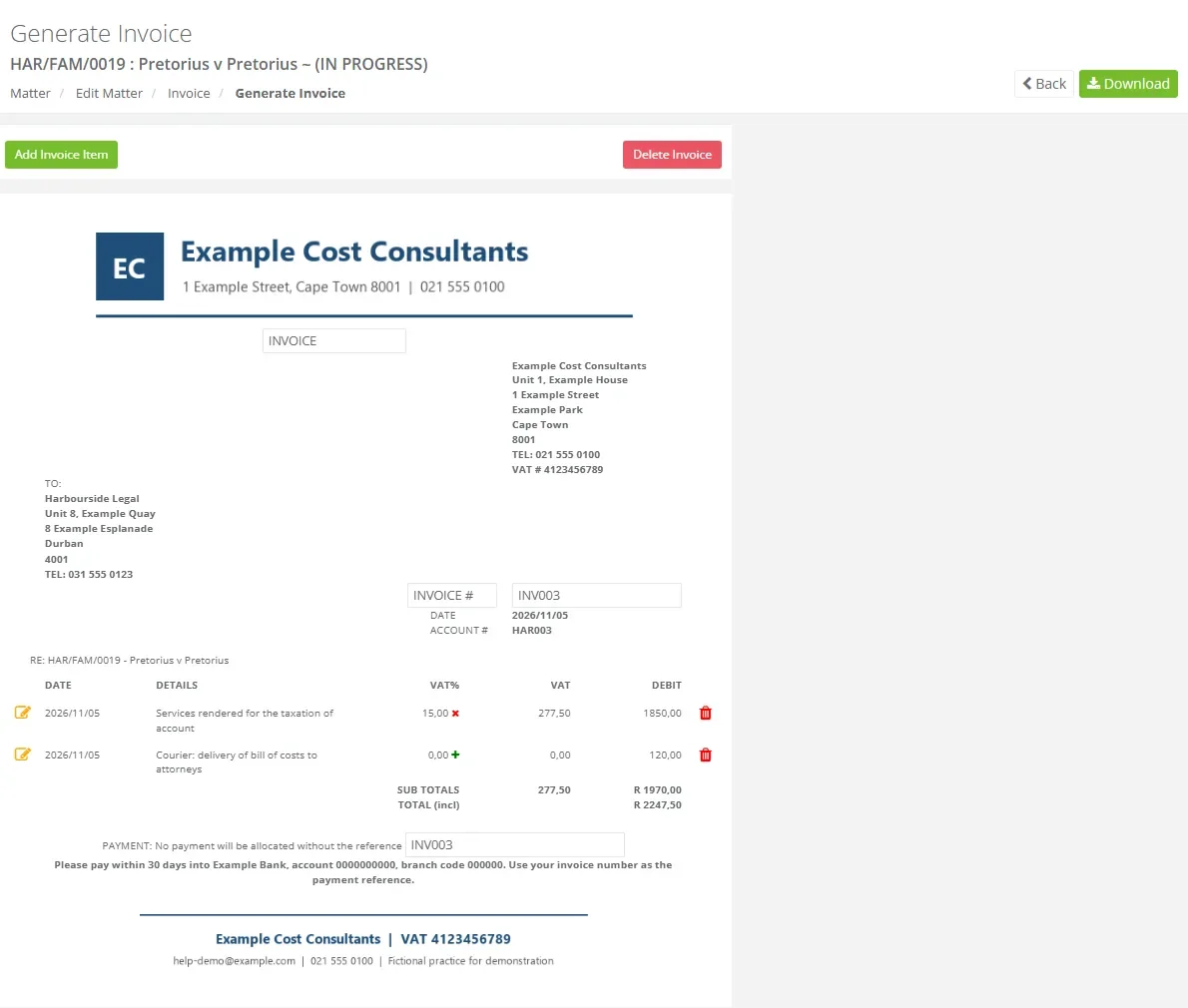
The new invoice opens on the Generate Invoice screen. Its lines depend on what has been invoiced before:
- On the first invoice for a matter, you get one line for the drafting amount (Services rendered for the drafting of account) and one for the taxation amount (Services rendered for the taxation of account), if each is more than zero.
- On a later invoice, you get one line for whatever part of the two amounts has not yet been invoiced (Services rendered for the drafting and/or taxation of account).
- If everything has already been invoiced, the new invoice has no lines.
Edit an invoice
Each line has icons at the end of the row:
- The orange edit icon lets you change the line's date, description and amount. Click the green save icon to keep the change, or the orange cross to cancel it.
- The red cross in the VAT column removes VAT from that line. The green plus adds it back.
- The red bin deletes the line after you confirm.

To add your own line, for example a courier fee, click Add Invoice Item. A line with today's date, the description Description and an amount of zero is added; edit it as above.
The INVOICE heading and the invoice number box at the top of the screen can be typed over. What you type there only appears on the PDF you download next; it is not saved with the invoice.
To remove the whole invoice and its lines, click Delete Invoice.
Once a receipt is allocated to an invoice, the invoice becomes read-only and shows Receipts are linked to this invoice. Invoice marked as readonly. To change it, delete the receipt first.
VAT on invoices
Every new invoice line is charged VAT at the rate that applied on the line's date, and the screen shows the rate next to each line. The SUB TOTALS and TOTAL (incl) at the bottom include it. Cost Consulting adds VAT whether or not a VAT number is captured for your company, so if you are not registered for VAT, remove the VAT from each line before you download the invoice. Lines that should never carry VAT, such as disbursements you pass on at cost, need the same treatment.
Download an invoice
Click Download to save the invoice as a PDF named after its number, for example Invoice_INV003.pdf. The invoice is then marked as printed, and the print date shows on the screen. Editing the invoice afterwards clears the print date, so you can see it needs printing again.
The PDF carries your company's details, logo and payment instructions, with the line PAYMENT: No payment will be allocated without the reference. You set these up under your company information; see Setting up your company information.
The invoice list
Clicking Invoices in the matter toolbar shows every invoice for the matter with its Invoice Number, Date, Total (Incl.), Outstanding Balance and whether it is Printed and Fully Paid. Click an invoice to open it.

Invoice numbers run in one sequence for your whole company: INV001, INV002, INV003 and so on, whichever matter they belong to.
Record a receipt
A matter needs at least one invoice before you can add a receipt.
- Open the matter.
- Click Receipts in the matter toolbar, or Add Receipts on the Edit Matter page.
- Click Add Receipt.
- Enter the Date the payment was received.
- Enter a Description, for example who paid and how.
- Enter the Amount.
- Under Allocated to Invoice, leave ticked the invoices this payment is for. All unpaid invoices are ticked to start with.
- Click Save.
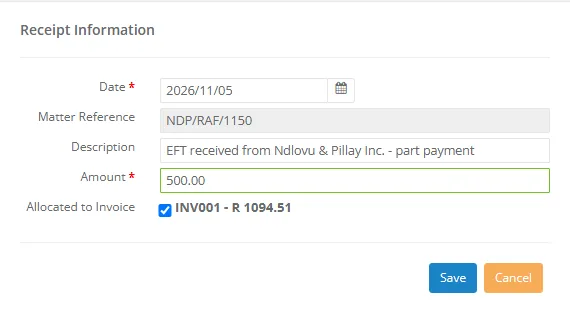
The amount is allocated to the ticked invoices up to each one's outstanding balance. If the payment is more than what is owed, the rest stays on the receipt as unallocated. When an invoice's outstanding balance reaches zero, it is marked Fully Paid.
The receipt list shows each receipt's number, Date, Allocated Amount, Unallocated Amount and Total (Incl.). Receipt numbers start with RCP followed by a number the system assigns, for example RCP012356. A saved receipt cannot be edited. To correct one, open it, click Delete and add it again.
Check what is owed
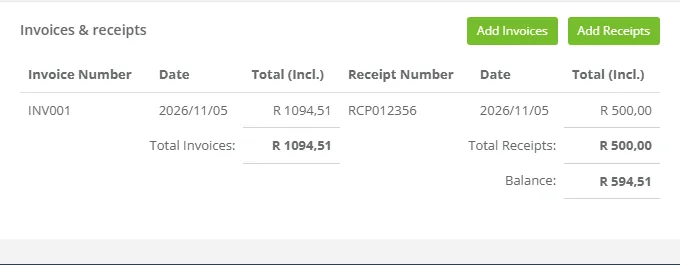
The Invoices & receipts box on the Edit Matter page lists the matter's invoices and receipts with the Total Invoices, Total Receipts and the Balance still owed.
To see what a firm owes across all its matters, use the firm statement; see Firm statements and progress reports. The Reports > Unpaid Matters report lists every matter with an outstanding balance; see Running reports.
Pro forma invoices
A pro forma is a quote-style invoice you can send before you bill. It is built from the same drafting and taxation amounts as an invoice, but it does not count towards the matter's balance and you cannot allocate receipts to it.
- Open the matter.
- Click Pro Forma in the matter toolbar.
- Click Add Pro Forma, then Yes, create Pro Forma!.
- Edit the lines on the Generate Pro Forma screen the same way as on an invoice. Use Add Pro Forma Item for extra lines.
- Click Download to save it as a PDF.
Pro forma numbers run in their own sequence: PF001, PF002 and so on.